#001 – Bobby Hewitt
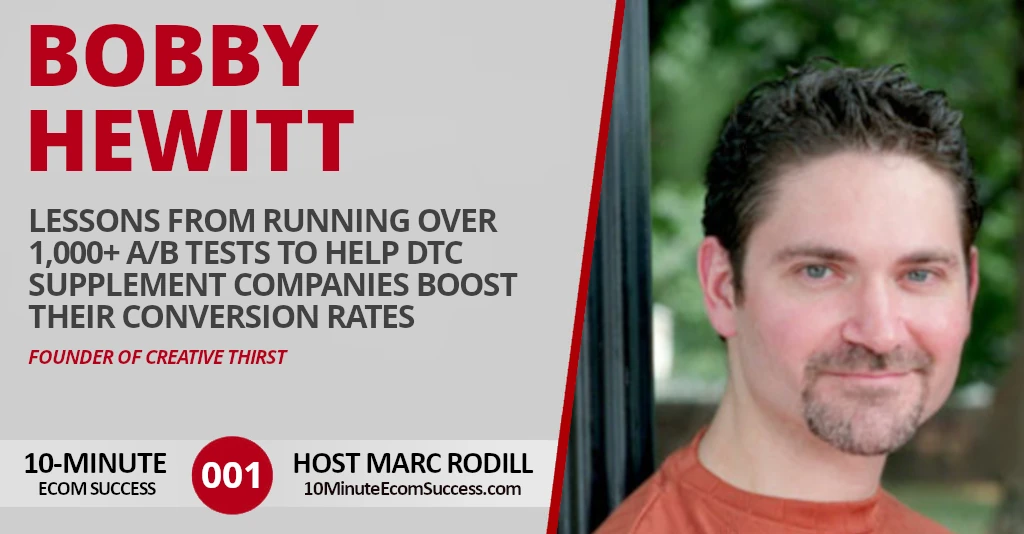
Bobby Hewitt of Creative Thirst shares how he helps DTC supplement companies optimize their front-end conversion rates and grow lifetime customer value after conducting 1000+ A/B tests.
Marc: Hey, it’s Marc Rodill with 10 Minute Ecom Success, and today my guest is Bobby Hewitt. The founder of Creative Thirst, Bobby’s dedicated his career specifically to helping dietary supplement companies maximize their profitability with strategic digital marketing, funnel optimization, and robust split testing.
He’s a contributing author to Google Analytics Breakthrough: From Zero to Business and the voice behind the Health Supplement Business Mastery podcast, where he pulls back the curtain on his insights and his strategies that he’s learned from his more than a decade of experience growing health supplement companies.
And with that said, Bobby, thank you so much for making the time to be here today.
Bobby: You’re welcome, Marc. Happy to be here.
Marc: Absolutely. I appreciate it. It’s my pleasure. And so here’s my question for you today, okay. What single skill or marketing strategy is really producing the best results or has been the most valuable in helping your clients successfully build up their supplement companies?
Bobby: Great question. So the problem is. There’s not a single strategy. It really depends on the stage of your supplement business. So if you’re at an early stage looking to break through, one strategy that works is to focus on only one subset of the market. Those people that are problem aware. They know they have a problem, but they may not know about your specific solution.
But if you’re at a later stage looking to scale, then you have to use a different strategy. And a strategy that works for that type of business is to focus on the unaware buyers. Complete opposite. These buyers are the group that aren’t aware that they have a problem. They need to be educated about both the problem and your solution.
Marc: So then, once you identify the problem, agitate the problem, you can present the appropriate solution, which of course is your product.
Bobby: Exactly.
Marc: Okay what do you really start with when you explore, maybe a startup supplement founder, what is like some boots on the ground steps, what’s your process look like for identifying, are we solving the right problem? Are we agitating properly getting that traction?
Bobby: Yeah. Well, it comes down to the market, right? And how big the total addressable market is, how big the TAM is that you’re going after, the competitors in that market, what angles, or really problems, are they going after? Because supplements solve so many different problems, right?
We have one supplement that solves five different things. It solves stress, it solves sleep, it solves this, it solves that. But really honing in on, which one of those is really going to be the flagship reason people are going to buy this? And that goes back to the market, that goes back to the problem, that goes back to the competition.
You can either take the strategy, go right in, and more or less model the competitor, right? Thinking that, there’s a stream of money in the marketplace, and you’re just tapping into that stream works sometimes, but not always. Or you can take the sort of the strategy of, these are the categories that people are going after with this supplement, or the problems, right?
And what are they kind of not doing with that particular category? What’s the gap that they’re not filling? To become better at that kind of strategy, it’s really ideal to kind of focus on the solution. But you want to focus on the solution, not at the detriment of the problem. Because the problem is important for any stage supplement company at all.
So to focus on the solution side, some of the things you can focus on is, how your supplement actually works in the body, right? The unique mechanism of action, what it actually does inside the body to make it work, right?
Sometimes that’s a better marketing story that competitors are not telling. Sometimes that’s a better supplement formulation, right? And sometimes that’s just using key ingredients in dosages that already have clinical studies that your competitors are not using, or don’t have, or are unwilling to improve the product.
Marc: Okay so let’s shift gears to a more late stage supplement company, they’ve sort of established their market. They have something that’s working. They’ve got traction. What would you really focus on there?
Bobby: So there I’d focus on a couple of things. One is really going broad and finding the right hook that brings them in. So again, if we’re going broad, we are focusing more on what is the newness of it. Or what is going to hook them in?
Because remember that going broad, they’re not aware of the problem. They’re not aware of the solution. They’re completely unaware. This is the broader market. So in order to do that, you need a better hook. Sometimes that hook is not related to the product at all. Sometimes that hook is totally different.
And that’s where creativity comes in, which you don’t really need if you’re at the earlier stages of the market.
Marc: So you would have different sorts of hooks to capture a larger, broader audience, and you would test different hooks to see how you can expand on that first, Problem, Agitate, Solve. You would see, how can we grab their attention? Where can we find a match between their attention, and this problem? And you would split test different hooks.
Bobby: Exactly. Cause you’re really looking to see what resonates right with the market. And nobody knows, even though I’ve been working in this field for over 10 years. I couldn’t tell you, “Here’s the exact hook you need. This is the winning one.”
Nobody can tell you that. It’s really comes down to what they’ve heard before, what they’re hearing now by other competitors. And what is kind of juicy, what is attractive, what is going to pique their interest. And sometimes that’s a completely off the wall kind of thing.
Marc: Right.
Bobby: You still need a hook for the early stage, but not in the same way. A later stage, you’re looking for a hook that kind of has legs, that resonates, that’s going to get a lot of interest, that’s intriguing. Because you’re really looking to interrupt and capture as much of the market as you can, and keep them hooked long enough in order to hear your sales message.
Marc: So once you develop additional hooks, you can really build upon your initial foundation of addressing that problem, where you were approaching it in a more straight lace fashion.
Bobby: Yeah, exactly. As long as you tie it together, right? The hook has to be tied with that part of it. And it’s not really about coming up with multiple hooks. It’s really finding the right one. A really strong, good hook could last for several years before it starts to die out because the whole market it’s much bigger than you really realize. You’re not really reaching half of the market. So a hook has a longer life.
Of course, it depends what advertising platform you’re on as well. And how limiting that advertising platform is, you know, based on other factors,
Marc: Their restrictions, or whatever they’ll allow you to say or do.
Bobby: Exactly.
Marc: That makes sense. And so your hook also depends a lot on, like you said, the competitive landscape, sort of what the information in the marketplace is currently, what they kind of know or are hearing about.
And that could shift. There could be a lot of different variables. A hook might work for a few years and then after the information environment changes, it might lose a little steam. So you go back to the drawing board.
Bobby: Right. Or the market could easily get distracted as well. Where especially this happens like every four years. Politics. They get distracted from something else or they get distracted by a global pandemic or a giant earthquake, or some other natural disaster. And then that hook starts to not work as well, because they’re just distracted quite honestly.
Marc: All sorts of variables essentially outside of our control. But if we want to adapt, we got to be flexible, and keep working at it. So the current environment could be distracting in the political landscape. Absolutely. And then is there a big core number two thing that you would focus on to really scale an operation?
Bobby: I would focus on the offer. It’s probably the biggest lever of everything, honestly, and crafting that offer at the right price, the right quantity, the right elements to it. Scarcity proof, keeping the guarantee strong, those elements all encompass what a good offer is. And more, quite honestly. But the offer has a lot to do with it.
Marc: You can get some pretty significant bumps out of adjusting the offer, restructuring the offer basically.
Bobby: Yeah, big time. And a lot of people don’t realize that the offer, is something that some people are hesitant to really change, or give away, or drop the price on. But what a lot of people don’t realize is that you have to have a front-end acquisition offer that’s bringing you in customers. Which may not be the same offer that you’re giving on your website.
It may not be an offer that you like, or want to do. But it’s the lifeblood of bringing in buyers to the business. Once you have buyers into the business, now you could sell them on the back end. You could sell them on upsells on the front end. And you can build more lifetime value with those buyers.
But if you don’t have that buyer engine working because you’re limiting the offer part of the structure, right? Or you’re just too afraid to say, “We can’t give away the price, at this low.” I’ve had clients that resisted that before.
But then you’re never going to get that traction. You’re never going to get those buyers, that blood, into the business, in order to pump the rest of it up through the body, the veins, the heart, the whole thing. You need that traction. You need a front end acquisition offer, because that front end acquisition offer is really getting a cold buyer. Whether you’re big and strong, or small, whatever stage you’re at.
It’s likely going to be different than the offer that you’re going to want to do, or feel you have to do, or feel like you don’t want to discount, because your product is this valuable. You often have to go into the hole, in order to make up the money later on the backend.
Marc: So another way to say that is you would deliberately restructure the front end offer, maybe even at a loss, in order to pump blood into the system. So on the backend, you could increase that customer lifetime value, and it’s worth it if you have an effective front end acquisition offer, so that way you have the opportunity to build that customer value, is what you’re saying.
Bobby: That’s exactly right.
Marc: Awesome. That’s awesome. All right. I love that answer. I know that “it depends” and “test” is definitely what we see a lot when it comes to marketing. I do want to shift gears here and talk a little bit about you. What Creative Thirst really is best known for, what you really specialize in. And how does that help clients with their goals of achieving success, and getting off the ground, or really scaling their supplement business?
Bobby: Yeah, sure. Absolutely. So at Creative Thirst I work with supplement companies. That’s the only type of company that I work with. Those are supplement companies selling direct to consumer online. So it’s direct from their website.
If they’re selling on Amazon, I can’t help you. If you’re selling in stores, I can’t help you. But if you’re selling directly to consumers and driving traffic to a landing page, or a shopping page, or a product detail page, and you’re trying to sell your supplement to acquire a buyer, that’s where I can add fuel to the fire.
So what I do is I focus on three areas. First area, is increase in conversion. So basically the conversion rate optimization, the acquisition of those buyers. Second area is lifetime value, getting more of those people money on the back end to grow the business. And the third area is average order value, getting more of those people to buy on day one or day zero, depending how you look at it, so that you can offset a lot of your advertising costs.
Marc: Yeah. That is really where the bread and butter tends to be. And so I appreciate you coming on and giving us your most valuable strategy that you use. So let me just ask you, how do people find out more about you and Creative Thirst and what you do?
What’s really the best place to find you?
Bobby: Honestly, the best place to find me is at CreativeThirst.com. There’s tons of blog articles. There’s a podcast. The name of the podcast is Health Supplement Business Mastery. It’s on iTunes, on Spotify. It’s pretty much everywhere you would go to find your podcast.
Just give a search for supplement marketing or Health Supplement Business Mastery, or Creative Thirst in your search engine. You’ll find it.
Marc: I did listen to a few of those episodes recently, and I would say there’s quite a few nice golden nuggets in there direct from experience, so I appreciate you putting that together.
Bobby: Thank you.
Marc: Absolutely. I appreciate you coming on. Thank you so much for your time. And bye for now.
Bobby: Thanks so much, Marc. It’s a pleasure.