#019 – Kai Davis
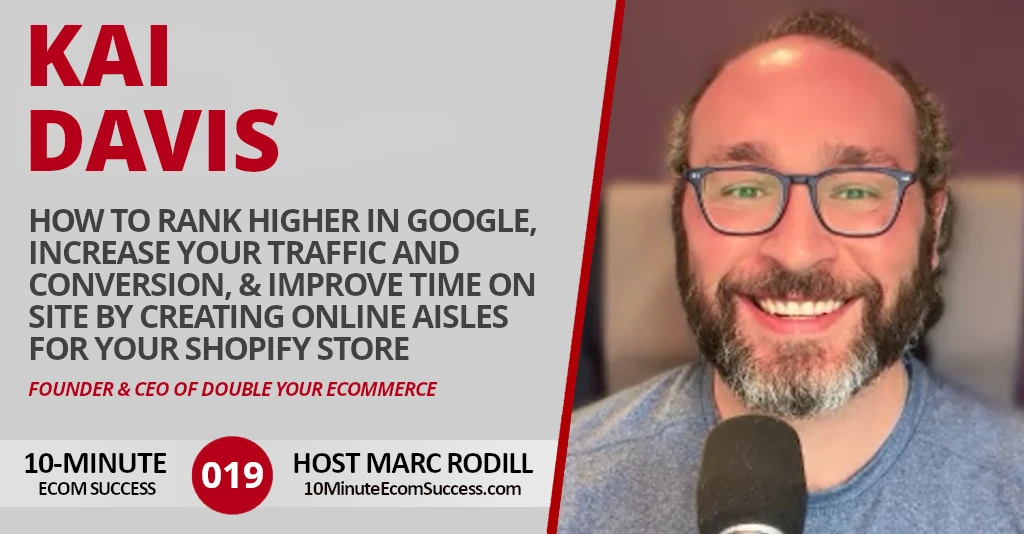
Kai Davis founder and CEO of Double Your Ecommerce shares a SEO strategy that causes your ecommerce site to rank higher in Google, increases your traffic and conversion, and improves time on site by optimizing your online shopping aisles.
Marc: Hey, it’s Marc Rodill with 10-Minute Ecom Success. And today, my guest is Kai Davis, founder and CEO of Double Your Ecommerce, a done for you search engine optimization and growth marketing service for Shopify stores, who has helped more than a hundred merchants get found online, rank higher in Google, and drive more high quality, targeted buying traffic to their stores. He’s referred to as the secret weapon of SEO for ecom by some of the best in the business. And so with that said, Kai, thanks for joining me, man.
Kai: Truly thrilled to be here. Thanks so much for inviting me on.
Marc: Yeah, it’s my honor to have you. And so let’s jump in. So, Kai, you know, being that this interview series is really designed to help D2C shop owners scale, six, seven figures and beyond, what’s the single best thing that you teach or you implement that they can learn from to help scale their operation?
Kai: Absolutely. I was so excited for this question. So Shopify stores are leaving so much money and traffic on the table with under optimized collection pages. Oftentimes, stores will either, they’ll just show up, they’ll set up their site, they’ll have their products and will create five, six, a half dozen collection pages, maybe a Shop All page, but that’s not really giving Google what they want.
Google loves collection pages. They’re high quality for commercial searches for transactional searches, people searching for things like, canvas tote bag. Google is like, “Oh, we really want a collection page with a bunch of options here to show to people.” And if your store doesn’t have collection pages, or it doesn’t just do a couple quick things to optimize them, the SEO title and the collection description, you truly are leaving money and traffic on the table.
Marc: Wow. Okay. So when did that come on your radar, collection pages?
Kai: About two, no, three years ago, I was doing a number of SEO audit projects and I started using this process I call the page type performance analysis. Basically I got it in my head. Okay. I want to see, for any Shopify store. If you look at all the products in aggregate, all the collections in aggregate, the homepage, the blogs, how much traffic are they bringing in?
How’s that traffic converting? What’s their value per visitor? What I consistently saw is, products do well, homepages bring in a ton of branded search traffic, but collections are truly the secret weapon. They bring in high quality traffic. Google likes this traffic. The traffic converts well. And so I started seeing this and I started leaning into it with my clients.
“Hey, we need a collection SEO strategy. We need to set up some pages. We need that. Optimize your existing collections.” What I consistently see is if stores put a decent amount of effort into optimizing their collection pages, get that SEO title, make sure the keywords in there, write a hundred word collection description, Google starts saying, “Oh, wow, this is a really relevant page” for that commercial search or that transactional search.
Let’s start ranking it a bit higher.
Marc: Awesome. And so did you say in the beginning, just a few collection pages they had? Five or six? And then what does that look like when they start working with you? How many collection pages are we actually talking about?
Kai: I don’t recommend going too hard too fast.
So I’ll typically take a store and say like, “Hey, let’s start by adding another 15 collection pages here.” So get them stood up. Have your existing products in there. Basically, you know, a collection page is like an aisle for your store. And because we’re selling online, we can have an infinite number of aisles, or at least dozens of aisles, in our shop.
So if I’m working with a store, I’ll look at the data, often search console, Google search console, or third party tools like Ahrefs or SEM Rush to get an idea of keyword opportunities. Where are keywords that your existing collection pages are ranking maybe 10th, maybe 20th, maybe 25th? That to me is a signal that either, the pages are under optimized, you don’t have a good SEO title, you don’t have a collection description, or it’s just sort of a little squishy.
Maybe you have a collection page set up for canvas tote bags, but it’s ranking really well for New York City tote bags. You probably should set up a second collection page explicitly targeting that new term, and let Google know, oh hey, we got an aisle dedicated to this thing people are searching for.
So, they’re really, really impactful. You often don’t need to go like, okay, we’re going to add a thousand collection pages this quarter. It could be as easy as, we’re going to optimize the dozen we already have. We’re going to add a new dozen. Then we’re just going to wait for two months and see how they’re doing.
Marc: Wow. So that’s almost like, if you were to go in person to a department store, like you said, it’s like actually shopping an aisle basically, where you have all these different choices. And so obviously people like to shop, right?
I mean, that makes sense. Now you said, they might have these terms, search terms, keywords, whatever. I think you said listing 20, maybe more, obviously. What kind of results have you seen? And then, you got any best practices?
Kai: Yeah, results I’ve seen really are just like a steady consistent increase in traffic and revenue.
It’s not going to be like, hey, we built the pages and next thing you know, we added another zero to our annual revenue. But what it will be is, our traffic is starting to trend up, and with a little bit of time, oh, we’re starting to see that traffic better convert into purchases. I love using Google analytics for this.
I’ll just filter down to all collection pages and just look at those top level stats. How are our collections doing? So oftentimes the results are, slow, steady, incremental progress to bring in more traffic and revenue.
In terms of best practices, there’s two that I really harp on. I wrote a whole collection SEO guide. We could link to in the show notes if people want to dive deep into it. It’s a free resource, but the two most impactful bits for collection optimization, the SEO title is number one. That bit that shows up in the browser tab and in the search results, Google sees it like the headline on a newspaper story.
It has a lot of weight for SEO. So oftentimes I’ll go in and just advise client. Okay, you got this, a tote bags collection, but the SEO title is just “bags,” or maybe it’s just “tote.” And Google’s like, “I can kind of get what this is, but can you just give me another hint?” And so just making it a little more clear in that SEO title pays huge dividends.
The other high impact bit is that collection description, that little blob of, you know, 75, a hundred words that shows up on collection pages. It’s often the most impactful on-page content for a collection page. So if your store doesn’t have any collection descriptions. Just, you know, quickly banging one out, almost as if, you know, you had a brick and mortar store and somebody walked in and was like, “I’m looking for a canvas tote bag, do you sell them? Tell me about them.”
Just jot down, you know, the 75 words that come to mind that helps Google understand, oh, this is what this page is about. And it helps that customer understand, oh, this is what that page is about. So it doesn’t need to be too deep on the best practices. Oftentimes that 80/20 that simple path is optimize that SEO title, get a collection description in there, then give it a little time.
Marc: Awesome. Okay. And so you’ve worked with a lot of merchants, right? So what are some of the challenges that you’ve seen going down this road? Has it always been kind of straightforward? Does Google updates change things? What are the challenges that you run into when you’re trying to set up these collection pages?
Kai: There’s a huge amount of hesitancy around almost, the aesthetic nature of it. So when you think about that collection page and the shopping experience, we’ve got two different things going on. We want a little bit of content there for SEO. So Google knows what this page is about.
But we want it to be a clean and clear shopping experience. And so if the theme isn’t well designed, we have this hundred word blob of text, and so it’s like, “Oh, there’s a headline, there’s text, this is messy.”
And so sometimes I’ll work with merchants who push back and like, “We don’t really want to add content to our collection pages. How do we rank without it?” And I’m like, unfortunately there’s not really a path for that. We need this content, to rank.
Sometimes they’ll pull off details, like, you might’ve seen this yourself, the headline on a collection page, or the description itself, to improve the aesthetics. But the downside is now every collection page looks identical to Google. It’s just the product, right? There’s no text. So those are the main challenges I run into, a hesitancy around adding this content to collection pages, but man, the value is really there.
Marc: Is there a lot of skepticism about this when you first work with clients? Are they hesitant, basically is what you’re saying?
Kai: Some, not a lot of hesitancy. Sometimes there is hesitancy. A lot of people in the ecommerce space come in thinking like, “Hey, the path to growth, A) product SEO, got to get our products ranking higher. B) blog SEO, got to get our blog posts ranking higher,” but oftentimes, this is what led me to that page type performance analysis I referenced.
Oftentimes your blogs might bring in a ton of traffic, but no revenue. Your products are going to be in the middle. And in my experience, collections bring in a decent amount of traffic, but it’s really well converting, and has that high value per visitor. So sometimes, it could be a conversation with the merchant just to get on the same page in terms of, “Okay, this is the ultimate goal we’re looking for.” The best lever we can move is collections.
Marc: That’s awesome. So they have much higher buying intent.
Kai: Hugely, hugely. It just aligns so well with that commercial intent and the way I even experience it when I’m shopping is like, if I Google a thing, and I land on a product page, I really only have sort of two paths. I can move forward and purchase that individual product. Or I could hit the back button and go back to the Google search results, on a competitor.
But when you land on a collection page, maybe there’s just three, maybe there’s 30 different products listed there. I could open up a bunch of tabs, I could start comparison shopping within this one store, rather than across multiple stores.
And that just seems to consistently lead to that higher purchasing intent, that higher buying intent. Folks are engaging, they’re strolling the aisles, they’re picking out products, and then they end up purchasing.
Marc: It sounds like also there’s more time on site, time on page, right? And so that was one of my questions, do you need a lot of products in the collection? You said 3, or 30, could be any?
Kai: Could be any. I really think the aisle metaphor is strong because like when you walk into a store, there might just be a small endcap where they’re like, “These are the three notebooks we have.” And you’re like, “I’m searching for notebooks. This is what I wanted.” And so I’ve had success with collections with as few as two products in it.
Occasionally, I’ve done one product collections. I personally like as a minimum, three to four, just to offer some shopping experience, but it could be really squishy. Like when we zoom out, collection pages are basically a really high intent landing page, for commercial, transactional traffic. And so if you only have one product on there, it’s fine.
It might be a little squishy of a customer experience, but we’re still giving Google and that person searching what they want, a dedicated aisle, a dedicated page about this topic, and these products to browse through.
Marc: Okay, that’s awesome. And so interesting question, maybe, I don’t know. I have very light SEO background, maybe going back over a decade ago. Not my thing, I don’t do SEO, so I’m glad to have people on who know what they’re doing. But what should I ask you about this, that I didn’t ask you?
Kai: Oh. Oh, you know, it connects to collections. But one underappreciated opportunity is, building internal links to them. So Google really likes internal links. There are links on your page itself, on your site itself, just pointing to another page. You know, link from the home page to a blog post, from a blog post to a product, or a collection. Google really likes those.
They act as a vote of confidence for the page. And so whenever I’m doing collection SEO with a client, if they have a blog built, I’ll look at that as a significant opportunity.
So maybe we created, a dozen new collections, and they got three dozen blog posts. I’ll go through and just find, okay, which collections can we link to from these blogs? Both to, help that customer, they just read about how to wash a canvas tote bag, let’s link them to our canvas tote bags. And for SEO, because when Google crawls those blog posts, they’ll see these internal links, pointing to the collection pages, crawl the collection pages and see them as more relevant.
So just to add it on, using your existing blog content, to build internal links. Super, super high impact for overall ecommerce SEO and collection SEO. Don’t sleep on internal links. They’re like fertilizer for growing a garden. You’re going to sprinkle it down. You’re going to be like, “Hey, it didn’t do anything.” And then in three months, you’re going to be like, “Oh my gosh, things are popping everywhere.” Like they are really, really, really powerful.
Marc: Man, that’s awesome. So you really brought a lot of value there, but you mentioned earlier, you have this free resource, but if someone wants to find out more about what you do, how can they find out more?
Kai: Absolutely. I run the consultancy Double Your Ecommerce. We’ll get a link in the show notes. And if folks are interested in working together or are just like, “Hey, I got this SEO question for my Shopify store and I’ve just been scratching my head,” feel free to shoot me an email.
I always love to chat, shop, provide some help and value, and see if we might be able to work together, but we’ll try to get my email address into the show notes as well.
Marc: All right, Kai, thank you so much for coming on today man.
Kai: Hey, delighted to be here, thank you so much.
Work With Kai on Shopify SEO: doubleyourecommerce.com
Say Hi to Kai (Email): kai@doubleyourecommerce.com
Free Collection SEO Guide: Read it here
Deep Dive on Collection Descriptions: Read the chapter
Free Keyword Magic Spreadsheet: Get it here (email required)
Stay Updated on KeywordMagic.ai: Join the list